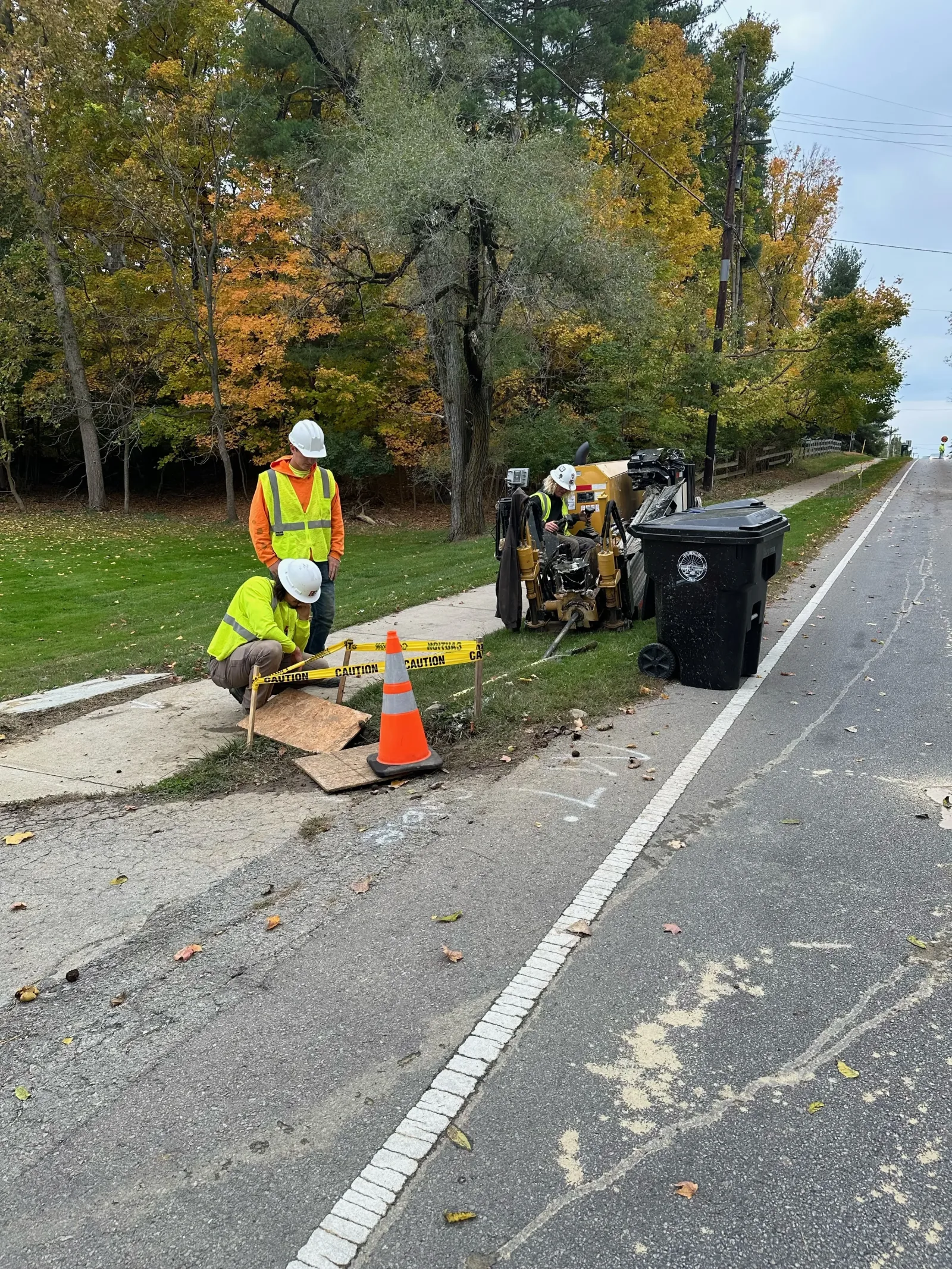
Horizontal directional drilling (HDD) is the cleanest way to get a utility line from point A to point B without tearing up everything in between. Instead of cutting an open trench across a road, a driveway, or a customer's lawn, we steer a bore underground and pull the new line through it. The surface stays intact, traffic keeps moving, and the restoration bill shrinks dramatically. It's the core of what B&G does, and it's why municipalities, general contractors, and developers across the Tri-State call us when a line has to cross something it can't be dug through.
Every bore starts before the drill does. We work with you to map the path, then locate and expose existing utilities so we know exactly what's underground — gas, electric, water, sewer, and communications lines all have to be accounted for. Once the path is clear, the process runs in three stages:
First, the pilot bore. The drill rig pushes a steerable drill head along the planned route, and we track its position and depth the whole way using a locating system at the surface. Because the head is steerable, we can follow a curve, drop under an obstacle, and come up exactly where the exit pit is. Second, reaming. We pull a reamer back through the pilot hole to enlarge it to the diameter the new line needs. Third, pullback. The new product line — conduit, pipe, or duct — is attached and pulled back through the reamed path in a single controlled pass. When it's done, the only disturbed ground is the small entry and exit pits at each end.
Directional drilling is how a huge share of modern underground infrastructure gets placed. We bore in fiber-optic and communications conduit, gas service and main, water lines, electrical conduit, and empty duct for future use. Just as important is what we go under. Road and highway crossings let utilities reach the other side without closing a lane or cutting pavement. Creek and stream crossings keep waterways undisturbed and avoid the permitting headache of an open dig in a sensitive area. We also bore under driveways, parking lots, sidewalks, railways, and mature landscaping — anywhere an open trench would be expensive, disruptive, or simply not allowed.
Open-cut trenching has its place, but the moment a line has to cross pavement, a waterway, or a finished property, the math changes. An open trench is cheap to dig and expensive to put back — you're paying to saw, excavate, backfill, compact, and then repave or re-landscape, all while traffic and property owners deal with the disruption. Directional drilling skips almost all of that. With a clean bore, the surface above is never opened, so there's little to restore, no lane closures dragging on for days, and far less risk of damaging the very infrastructure you're working around. For a contractor trying to keep a job on schedule, that predictability is the whole point.
Because B&G handles locating, boring, installation, and any needed restoration in-house, you're not coordinating three subcontractors and hoping the schedule holds. One crew owns the underground scope from the first locate to the last patch. That's how we keep projects on time and on target across Clinton, Warren, and Adams Counties and throughout the wider Tri-State — and it's why our work shows up clean every time. If you've got a line that needs to get somewhere it can't be dug, tell us about the crossing and we'll talk through the right approach.
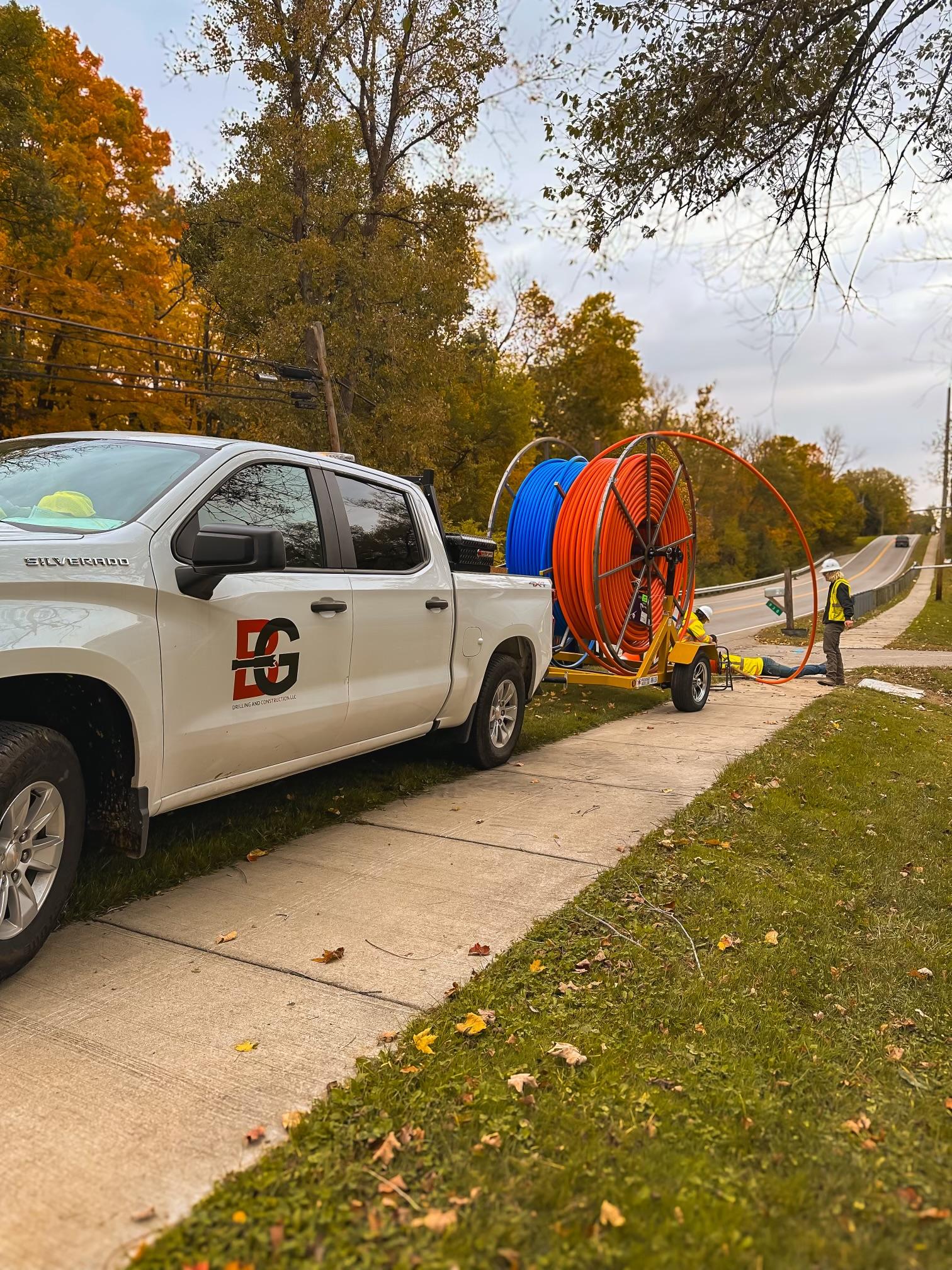
Horizontal directional drilling (HDD) is a trenchless method of installing underground utilities. We drill a steerable pilot bore along a planned path, enlarge it with a reamer, then pull the new line through — fiber, gas, water, or conduit — without digging an open trench. Only small entry and exit pits are needed, so roads, driveways, and landscaping stay intact.
Yes. Road and creek crossings are one of the biggest reasons contractors call us. Because directional drilling works underground, we can cross beneath a highway, a stream, or a parking lot without cutting it open or interrupting traffic and flow. We locate existing utilities first, plan a safe depth and path, and bore straight through.
On most jobs that cross pavement, landscaping, or obstacles, yes — once you factor in restoration. Open-cut trenching is cheap to dig but expensive to put back, and it disrupts traffic and property. HDD costs more per foot to bore but eliminates most of the restoration bill and downtime, so the total project cost is often lower.
Non-destructive potholing to safely locate utilities before a bore.
Fiber, water, sewer & electrical conduit installed to code.
We restore any disturbed surface to like-new in-house.
Tell us about your bore and we'll talk through the best approach.
Get a free, no-obligation quote on your directional drilling project from the Tri-State's underground experts.
Get a Free QuoteTell us about your project — location, type of utility, and timeline — and we'll get right back to you. No obligation.